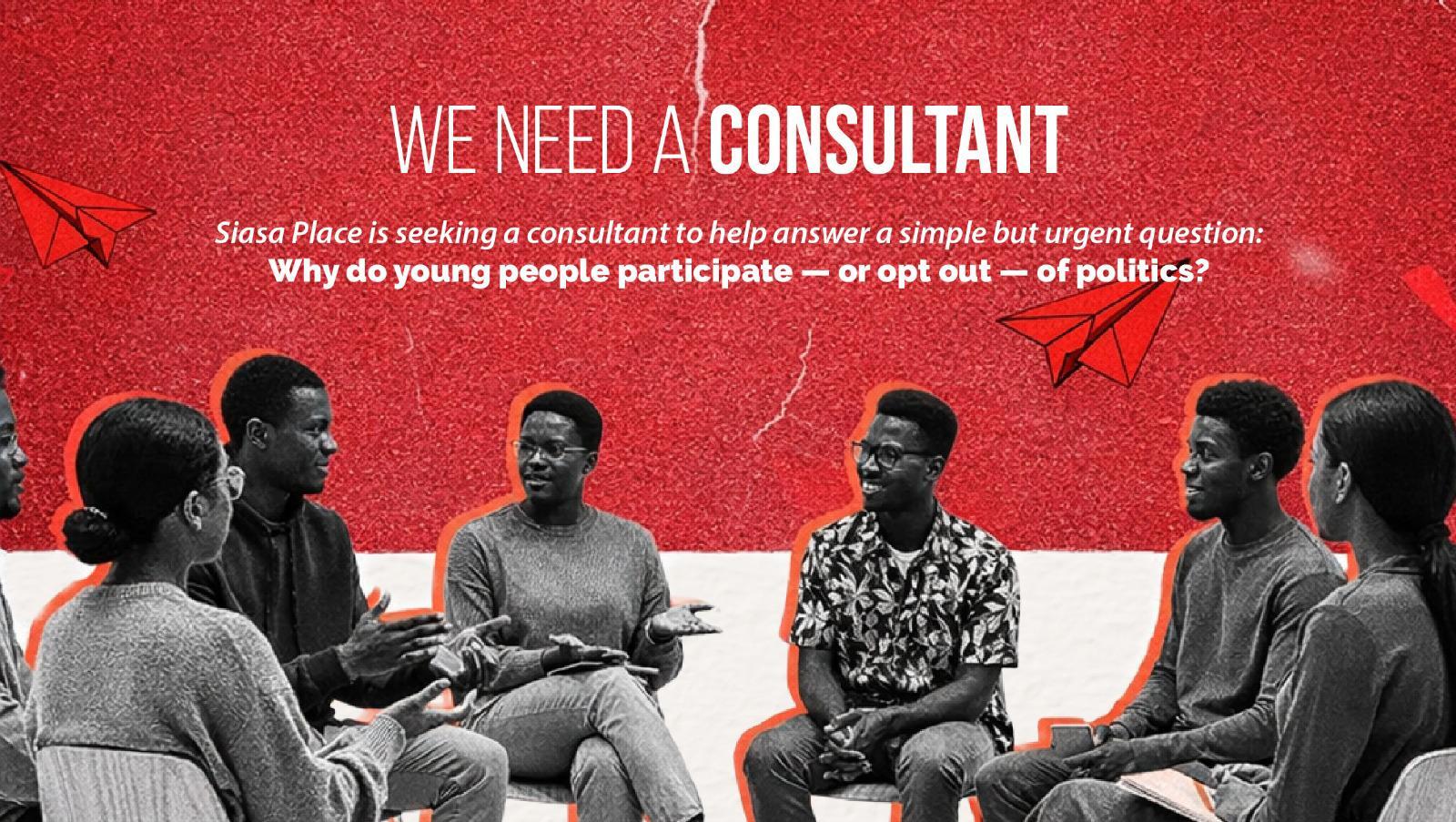
TERMS OF REFERENCE (TOR)
Youth Participation in the Electoral Process: An Anthropological Analysis of Drivers and Hindrances to Youth Political Participation Behavior.
Position: Research Consultant
Terms: Temporary (Approximately 21 days)
Availability: January – March 2026
- Introduction
1.1 Contextual Analysis
Kenya has made significant progress in strengthening democratic governance through the entrenchment of devolution and public participation in the Constitution. However, this progress has not been fully realized as has been observed since 2017 when the Independent Electoral and Boundaries Commission (IEBC) failed to meet its voter registration targets by over 2 million and in 2022 by 3.5 million while currently struggling to meet their target since 2025. This notwithstanding that young people have been facing challenges in accessing national identification cards, which directly affects their ability to register as voters which disproportionately affect them despite commanding the majority of 75% of the population according to the 2019 census report.
Barriers to youth political participation are not only technical or administrative but also social, cultural, economic, and institutional. These include mistrust in political institutions, exclusion from identity systems, gendered power relations, poverty, and perceptions that voting does not lead to meaningful change.
The consultancy is therefore expected to generate in-depth, context-specific, youth-centered qualitative evidence on the status of youth political participation in Kenya. The study will identify political, administrative, and structural factors that enable or hinder youth engagement and provide guidance to political stakeholders on targeted interventions to strengthen and increase meaningful youth participation.
- Overview of the UNDP Project
The UNDP project sought to respond to some of the challenges and gaps highlighted in the preceding section. The project targets youth with more focus on first time voters in Kenya, through existing organized community-based groups. The project intended to work with both national and county duty bearers in addressing the civic and governance challenges affecting young people at the local level.
1.3 ORGANISATIONAL BACKGROUND
Siasa Place is a youth-led and youth-focused civic-tech organization that is building confidence, skills, competencies and institutional structures necessary for meaningful and dignified participation of young people in politics, governance and civic life. Inspired by the Constitutional promise of the right to public participation, convinced of young people’s interest, potential and capacity to influence decisions that affect them, Siasa Place is leveraging technology to expand the reach and quality of young peoples’ engagement in the social, economic, civic and political life of their communities. Our three programme pillars cover themes such as Devolution and local accountability; Politics, tech and rights; Equality; as well as Youth Employability, skilling and mentorship.
1.4 Purpose, Objectives and Scope of the Assignment
With the above considerations in place, Siasa Place seeks a qualified and experienced consultant to conduct the study in Kenya, with the aim of assessing the drivers and barriers influencing youth behavior toward political participation, with specific reference to social, political, and economic factors, as well as national identification acquisition, voter registration, and voting.
Specific Objectives
- To examine the social, political, and economic factors that influence youth behavior toward political participation in Kenya.
- To assess the key drivers and barriers affecting youth access to national identification, voter registration, and participation in voting processes, including institutional practices and the influence of trust, exclusion, fear, and political disillusionment on youth behavior.
- To analyze information ecosystems, how digital platforms and narratives shape young people’s perception of politics, this includes misinformation and political communication that shape youth political awareness, mobilization and disengagement
- To explore variations in youth demographics in regards to participation, from first time voters, repeat voters, social economic status and rural vs. urban
- To generate evidence-based recommendations for strengthening youth political participation and informing policies, guiding civic engagement interventions in Kenya.
1.5 Scope of work
The Scope of Work under this consultancy includes the following;
1.5.1 Conduct an in-depth review of relevant literature and secondary data on youth drivers and barriers influencing youth participation in ID registration, voter registration, and voting in 17 Counties, to contextualize the findings.
1.5.2 Prepare an Inception Report outlining the evaluation methodology, sampling design, analytical approach, and data collection tools, aligned with the study target.
1.5.3 Undertake fieldwork in the 17 Counties to gather primary data through interviews, structured consultations, and other appropriate methods with sampled stakeholders engaged in youth governance processes.
1.5.4 Analyze data and produce a concise study report detailing the findings, lessons learned, and recommendations for future implementation.
- Deliverables
These include the following:
2.1 An Inception Report outlining the consultant’s proposed study methodology, analytical framework, sampling strategy, ethical considerations, and a detailed work plan for conducting the assignment.
2.2 A complete set of study data collection tools (qualitative and quantitative) designed to analyze youth access to national ID registration, voter registration, voting behavior, and the social, cultural, and institutional factors influencing participation.
2.3 A Draft Study Report presenting preliminary findings, emerging patterns, and initial analysis for review and validation by the project team and key stakeholders.
2.4 A Final Study Report providing a comprehensive assessment of the findings, lessons learned, and recommendations for future implementation.
The draft report that will emanate from this exercise shall be submitted in soft copy, to the Contracting Agency for review, within one week of completing the field work phase. Further, the consultant will submit the final report, within one week after receiving feedback from the Project contracting agency.
Approval of the final report shall be done by the Executive Director, Siasa Place.
3.0 Proposed Methodology
It is recommended that the successful candidate shall ensure the consultancy is conducted in a consultative and participatory approach that is both context-sensitive and responsive to the complexity of youth participation in civic and electoral processes.
The consultant should consider the use of a mixed-methods approach, drawing on both primary and secondary data sources to generate qualitative and quantitative evidence.
Data collection tools ought to be designed to align with the study objectives and target populations, ensuring accurate and reliable data capture. All data collected will be systematically collated, analyzed, and interpreted using appropriate qualitative and quantitative analysis techniques to produce coherent, credible, and policy-relevant findings.
4.0 Time-frame
This consultancy will take approximately (21) days, based on a reasonable ‘Level of Effort’ estimation.
These days will be spread from the day of signing of the contract. The consultant is expected to share a work-plan that indicates how these days will fit into the three phases of the consultancy; Inception, Fieldwork and Post-Fieldwork phases. The proposed plan will be reviewed by the project team in consultation with the consultant, before roll-out.
5.0 Profile of the Consultant
There are mandatory and desirable competencies of this;
Mandatory;
5.1 Solid experience in mixed-methods research, including the design and implementation of surveys and qualitative tools for governance, citizenship, or civic participation studies.
5.2 Extensive experience working on youth-focused programmes, particularly in areas related to civic engagement, political participation, identity, or rights-based advocacy.
5.3 Knowledge of and experience in working in the project county counties will be an added advantage.
5.4 Strong knowledge and practical understanding of Kenya’s national identity, voter registration, and electoral participation systems, including the roles of institutions such as the NRB and IEBC.
5.5 Proficiency in report writing skills in English language.
5.6 A degree in any of the following fields: public policy, monitoring and evaluation, project management, political science or in a related field is an added advantage.
6.0 Management of the Consultancy
The Programme Manager, Siasa Place shall be directly involved in the supervision and management of the consultant during the period of engagement.
During the fieldwork phase, the consultant shall work with designated county coordinators to ensure meaningful engagement with the stakeholders and successful collection of data from the sampled institutions and individuals.
7.0 Terms and Conditions of Engagement
These include the following;
7.1 The Contracting Agency (Siasa Place) will provide the consultant with the required information and support in setting up interviews with the identified respondents in the field.
7.2 The Contracting Agency commits to provide ‘Duty of Care’ to the consultant during the Field/Data Collection Phase of the work in line with Siasa Place’s policies and guidelines.
7.3 Upon contracting, the consultant shall be responsible for settling his/her taxes, apart from the statutory deductions that will be affected by Siasa Place, as a result of engagement in this assignment.
7.4 As part of the contracting process the consultants shall be expected to abide by all the policies of Siasa Place, inter alia, Child Protection, and Sexual Abuse.
8.0 Application Procedure
Interested applicants should send their applications addressed to the Programme Manager, Siasa Place, by Close of Business on 4th February 2026 via this link – https://forms.gle/2dkG5QjSfxx6xL5a7
Applications should include the following documents:
- Cover letter (max 1 page) outlining your suitability for this assignment
- Technical proposal (max. 8 pages). The technical proposal must outline the following;
- The consultants’ understanding of the TORs
- Proposed methodology
- Proposed work-plan
- Consultant’s relevant experience in previous related assignments
- 3. Financial Proposal (max. 1 page) outlining in Kenya Shillings, the consultant’s proposed cost for undertaking the study. This should include both the professional and logistical costs.
- 4. Attach a SAMPLE of a similar study report that you have conducted in the recent past.
- 5. List of referees