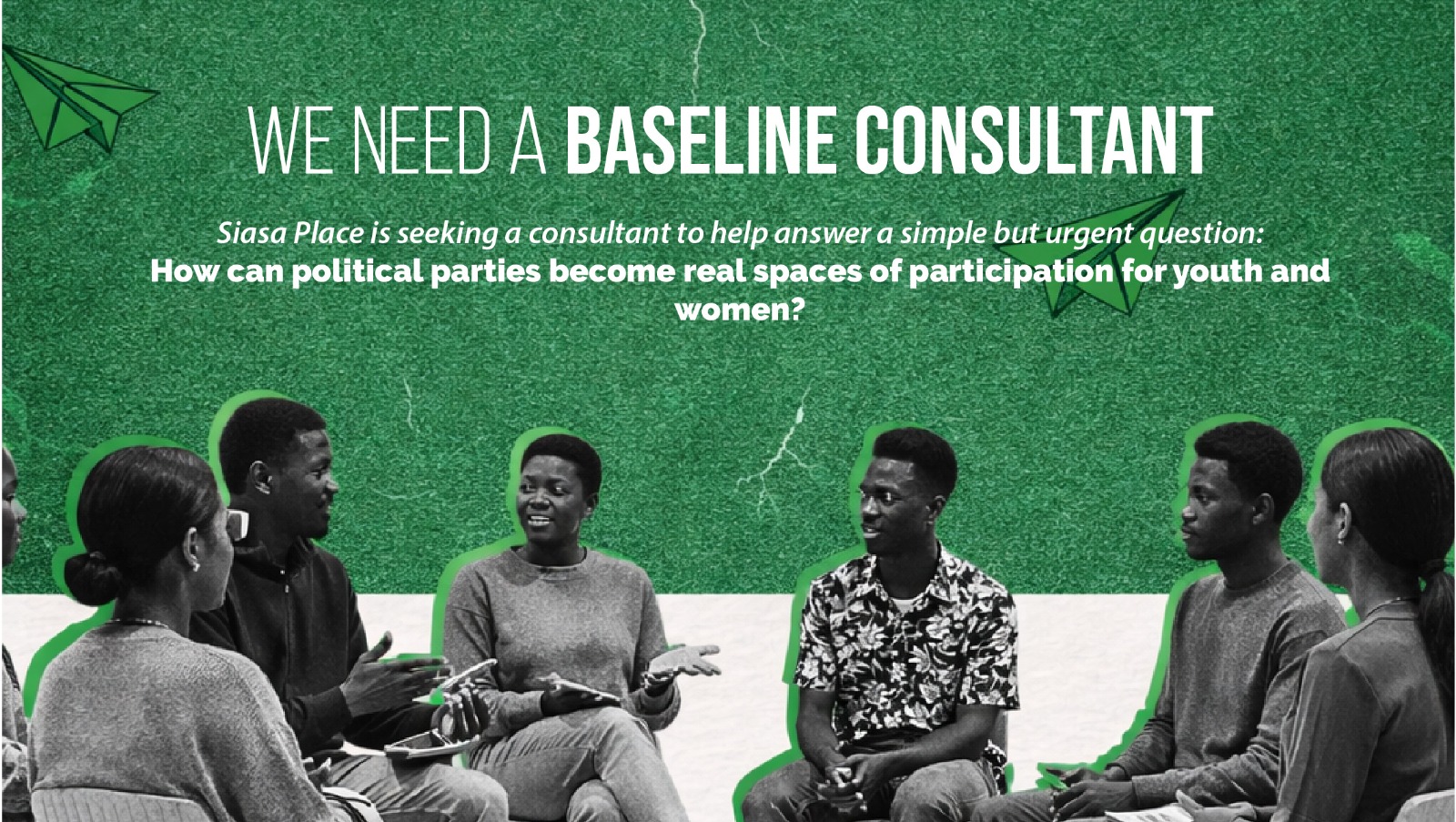
TERMS OF REFERENCE
Baseline on the status of youth and women’s political participation in political parties
Position: Research Consultant
Terms: Temporary (Approximately 30 days)
Availability: February 2026
- Introduction
1.1 Contextual Analysis
The Constitution of Kenya emphasizes the participation of stakeholders in decision making, particularly youth and women. However, realization of this has encountered both structural and systemic challenges resulting in the exclusion of youth and women who make up over 70% of the population. Despite constitutional guarantees under Article 10 (national values of inclusivity and participation), Article55 (mandating youth participation and capacity-building), and Article 174 (promoting inclusive governance through devolution), youth and women involvement is hindered by institutionalized barriers, limited youth and women understanding of the importance of their participation in political processes and absence of responsive forums for meaningful engagement in politics and governance. Consequently, their priorities are often overlooked, leading to mismatched priority projects resulting in poor services delivery and undignified living conditions.
By law, to be registered, a political party is required to have physical offices in at least 24 out of the 47 counties to facilitate the devolution of political participation for its stakeholders. These offices are also intended to serve as spaces for engaging stakeholders. However, due to lack of resources and lack of good will, most political parties operate only one national office, leaving the other 23 closed throughout the year. These offices are typically opened when parties seek clearance from the Registrar of Political Parties and are promptly closed again once the clearance is obtained thus limiting the people at the grassroots from participating in political processes.
It is also a requirement for all political parties to establish youth and women leagues structured down to the lowest level of governance to facilitate political participation. Most parties have yet to meet this requirement due to high cost implication involved in operationalizing because majority lack the financial resources due to low membership while they do not benefit from the political parties funds for failing to meet sixteen (16) members of parliament required by the constitution while those who meets the requirements lack the good will to use the resource to facilitate stakeholders political engagements leading to poor youth and women engagements in political and governance processes. This results in the exclusion of youth and women from day-to-day governance processes. Additionally, limited awareness of the importance of youth participation leads to very few young people and women getting involved. Consequently, they remain underrepresented in political and governance decision-making, their development priorities are often overlooked, and service delivery becomes non-responsive, ultimately contributing to an undignified quality of life.
Local culture, lack of awareness, and unresponsive platforms hinder minority groups especially youth and young women from participating in governance, thereby negatively affecting the realization of the constitutional promise of improved service delivery as outlined in the service charter, which aims to promote dignified living. For example, before marriage, women are culturally expected not to speak on matters of governance; after marriage, they are often treated with suspicion and face additional unreasonable demands such as being questioned on whether they have given birth in order to participate while in other circumstances the gender of the children are also used to determine their level of participation. This occurs despite the fact that they are equal taxpayers and consumers of public services, which gives them every right to demand equitable service delivery and to hold leaders accountable
Article 55 of the constitution of Kenya mandates the government to facilitate youth participation however, the government has not appreciated inter-generational dynamics and continues to use traditional means in conducting public participation and civic awareness which largely exclude youth and women from participating in governance leaving them disenfranchised. Youth and women have limited knowledge on the importance and avenues through which they can participate in politics and day to day governance including influencing youth and women centered development projects. They also lack skills and strategies to hold leaders accountable thus leaving them at the mercy of those in authority
1.2 ORGANISATIONAL BACKGROUND
Siasa Place is a youth-led and youth-focused civic-tech organization that is building confidence, skills, competencies and institutional structures necessary for meaningful and dignified participation of young people in politics, governance and civic life. Inspired by the Constitutional promise of the right to public participation, convinced of young people’s interest, potential and capacity to influence decisions that affect them, Siasa Place is leveraging technology to expand the reach and quality of young peoples’ engagement in the social, economic, civic and political life of their communities. Our three programme pillars cover themes such as Devolution and local accountability; Politics, tech and rights; Equality; as well as Youth Employability, skilling and mentorship.
1.3 Study Outcome
The study will produce an evidence-based understanding of the political, institutional, and operational feasibility of implementing a county-level intervention in Homa Bay that strengthens youth and womens’ participation in politics through interparty youth leagues and dialogue platforms. The feasibility study will generate practical insights, evidence, and direct input from youth league representatives, grassroots youth, and relevant civic actors to inform the design of a realistic, inclusive, and conflict-sensitive 2-yer project.
The study will pay particular attention to gender equality and social inclusion, examining how young women, marginalized youth, and youth with disabilities experience political participation and representation within political parties and at county level. Identified barriers will inform strategies for ensuring that future interventions promote equitable, inclusive, and meaningful participation.
1.4 Call-Out
Siasa Place seeks a qualified and experienced consultant to conduct a baseline evaluation and a feasibility study to ensure target group and stakeholder input for the DIPD project in Homabay County towards understanding the current prevailing situation, giving insights in how best to design the intended interventions, and strengthening the project’s design and results framework.
- Purpose, Objectives and Scope of the Assignment
The purpose of the consultancy is to assess the practical, political, and institutional feasibility of implementing a project that strengthens youth participation in politics in Kenya through youth leagues and dialogue platforms at county level.
The study will provide a foundation for designing a pilot project that can later be scaled into a long-term partnership and will allow for thorough co-creation in project development and partnership-building
The specific objectives and analytical focus:
To achieve this purpose, the consultancy will pursue the following interlinked objectives:
- Assess the political and institutional feasibility of supporting youth political participation through county-level youth leagues and dialogue platforms.
- Map key actors, networks, and stakeholders in Homa Bay, including political parties with active youth and women leagues, to identify potential partners, entry points, and enabling conditions for collaboration in Homa Bay.
- Conduct a stakeholder and actor analysis to assess the organisational capacity, leadership structures, internal democratic practices, and the representation and participation of young women, marginalized youth, and persons with disabilities within youth wings of political parties, and to map relevant civil society organisations, youth networks, and government institutions.
- Identify needs, motivations, and capacities and constraints among youth leagues and relevant youth-led organizations to guide realistic and context-sensitive project interventions.
- Analyse community perceptions of youth and women in politics to inform the design of inclusive, trusted, and locally legitimate participation mechanisms.
- Analyse gender- and inclusion-specific barriers to political participation, including social norms, institutional practices, and accessibility constraints affecting young women, marginalized youth, and youth with disabilities, and identify implications for inclusive project design.
- Assess how Kenya’s evolving political context ahead of the 2027 general elections, including youth-led protests, shifting political alliances, and rising political tensions, creates both opportunities and risks for youth political engagement
- Provide input and baseline evidence and analytical input to Siasa Place (SP) and The Alternative (ALT) to support the joint development of a shared Theory of Change, partnership framework, and risk mitigation strategy for a scalable 2-year project rooted in local realities and youth perspectives.
- Facilitate early engagement and trust-building among youth league representatives and local civic actors to ensure local ownership of the future pilot project.
The study will assess the feasibility of achieving the following preliminary outcomes of a future partnership project:
- Youth league representatives actively collaborate across party lines and engage in interparty dialogue.
- Youth league leaders in Homa Bay demonstrate increased awareness and application of democratic and participatory practices within their own organisations.
- Youth in Homa Bay voice political priorities and concerns in dialogue forums, and youth leagues respond by engaging with young people participating in the forums.
- Siasa Place and The Alternative, together with local stakeholders, test and document approaches for youth participation and interparty dialogue, producing knowledge and recommendations for meaningful youth engagement at county level and for scaling up to a longer-term program
The Scope of Work under this consultancy includes the following;
- Conduct an extensive review of relevant literature (secondary data) related to youth and women’s political participation in political parties in Homabay and Kenya generally.
- Develop an Inception Report with a clear methodology and data collection tools.
- Proceed to the field (in Homabay county) to collect the required primary data through interviews and consultations with all the sampled stakeholders in the youth governance and political participation space.
- Analyze the data, develop the baseline survey report addressing all the key data points and a commentary on the appropriateness (measurability) of the indicators in the outcome journal, and submit the draft to Siasa Place for review.
3.0 Deliverables
These include the following:
- An Inception Report, outlining the consultant’s methodological approach to this assignment, and a proposed work-plan.
- A set of comprehensive data collection tools that will be used to generate the baseline data. These tools ought to capture both qualitative and quantitative data.
- Final baseline and feasibility study report, which shall follow a draft submitted for approval to the project team.
The draft report that will emanate from this exercise shall be submitted in soft copy, to the Contracting Agency for review, within two weeks of completing the field work phase. Further, the consultant will submit the final report, within one week after receiving feedback from the Project Consortium Members. Approval of the final report shall be done by the Executive Director, Siasa Place.
4.0 Proposed Methodology
It is recommended that the successful candidate shall ensure the consultancy is conducted in a consultative and participatory manner that is both complexity-aware and context-sensitive. The methodology should be sensitive to political dynamics, gender equality and social inclusion, intergenerational power relations, and accessibility considerations, including the meaningful participation of young women, marginalized youth, and youth with disabilities.
The consultant should consider the use of a Mixed Methods Approach through primary and secondary data collection methods, which will yield both qualitative and quantitative data.
The data collection tools ought to be designed in a manner that corresponds to the sourcing for data for all the indicators in the draft project results framework. The collected data will have to be collated, analysed and interpreted in a coherent and systematic manner, using detailed data/information analysis method(s).
5.0 Time-frame
This consultancy will take approximately thirty (30) days, based on a reasonable ‘Level of Effort’ estimation. These days will be spread from the day of signing of the contract. The consultant is expected to share a work-plan that indicates how these days will fit into the three phases of the consultancy; Inception, Fieldwork and Post-Fieldwork phases. The proposed plan will be reviewed by the project team in consultation with the consultant, before roll-out.
The consultant will be expected to be in the field for about two weeks (14 days) days during the Fieldwork Phase. Other days will be spent away from the field in accordance with the proposed plan.
6.0 Profile of the Consultant
There are mandatory and desirable competencies of this;
Mandatory;
- Solid experience in mixed methods research including designing and conducting baseline surveys in youth and governance programmes.
- Extensive experience working in the youth governance sector, especially in capacity enhancement and advocacy programmes. Knowledge of and experience in working in the project county counties will be an added advantage.
- Knowledge and understanding of devolution and county government systems in Kenya.
- Proficiency in report writing skills in English language
- A degree in any of the following fields: public policy, monitoring and evaluation, project management, political science or in a related field is an added advantage.
7.0 Management of the Consultancy
The Programme Manager, Siasa Place shall be directly involved in the supervision and management of the consultant during the period of engagement.
During the fieldwork phase, the consultant shall work with designated county champions of the project consortium members to ensure meaningful engagement with the stakeholders and successful collection of data from the sampled institutions and individuals.
8.0 Terms and Conditions of Engagement
These include the following;
- The Contracting Agency (Siasa Place) will provide the consultant with the required information and support in setting up interviews with the identified respondents in the field.
- The Contracting Agency commits to provide ‘Duty of Care’ to the consultant during the Field/Data Collection Phase of the work in line with Siasa Place’s policies and guidelines.
- Upon contracting, the consultant shall be responsible for settling his/her taxes, apart from the statutory deductions that will be affected by Siasa Place, as a result of engagement in this assignment.
- As part of the contracting process the consultants shall be expected to abide by all the policies of Siasa Place and The Alternative Party, Child Protection, and Sexual Abuse.
9.0 Application Procedure
Interested applicants should send their applications addressed to Siasa Place, by Close of Business on 10th February 2026 via https://forms.gle/YtR5nULUMtJqcTQp8
Applications should include the following documents:
- Cover letter (max 1 page) outlining your suitability for this assignment
- Technical proposal (max. 8 pages). The technical proposal must outline the following;
- The consultants’ understanding of the TORs
- Proposed methodology
- Proposed work-plan
- Consultant’s relevant experience in previous related assignments
- Financial Proposal (max. 1 page) outlining in Kenya Shillings, the consultant’s proposed cost for undertaking the baseline survey. This should include both the professional and logistical costs.
- Attach a SAMPLE of a baseline survey report that you have conducted in the recent past.
- List of referees